1929 -1939
I do not have many memories between 1929 and 1938.
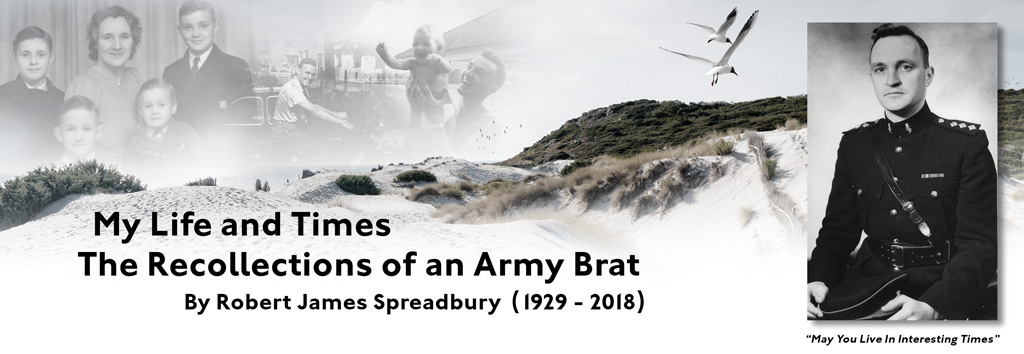
I was born in Bangalore, India in the state of Mysore on the 26th Oct 1929 to Sgt and Ms. L. R. Spreadbury. My dad was in the Royal Engineers attached to the Madras Sappers and Miners for a 5-year engagement.
I am indebted to some notes made by my Mother, Winifred Margaret, for the accompanying passages.
A Serviceman’s wife’s memories
In December 1927 I became engaged to a serviceman, then a Corporal in the Royal Engineers. Within a month he was posted to India to the Queen Victoria’s own Madras Sappers and Miners. Bans were arranged, we were married February 11, 1928 sailing for India March 8th on the troopship Nevasa.
Arriving Bombay, we transferred to a train to Bangalore, taking 3 days and nights, sharing an enamel plate and mug for meals, which consisted of a loaf, small tin of butter, bully beef stew, rashers floating in fat and small tin of cheese. Tea was brought around in a bucket. Our beds were the seats in the train and the luggage rack.
We were fortunate in that two families shared a first-class compartment, and after scouring the bath with sand collected by our husbands at the railway stations where we halted, we were able to bathe. Our fellow companions sharing, were a Sgt in the Royal West Kent’s, his wife and two boys ages 5 and 7.
Arriving in Bangalore, we were met by the RSM and Qtr. master and taken to our married quarters. There were some single men who were taken to the barracks.
From then on it was a strange new life getting used to the money Rupee, anna pye and pice, and some language mostly Tamil. Urdu was the language the men had to study and pass as instructors to various dialects some coming from outlying districts.
There was very little social life apart from social evenings in the Sgt’s mess occasionally. Sometimes our traveling companions from the Royal West Kent’s came to visit, but it was a three mile walk and the nights dropped fully by 7 pm.
Shopping was done by our bearer (boy) by chit, and once a month we ordered a gharrie (horse and carriage) on pay day to pay any bills and doing any other shopping.
For the first few weeks furniture was rented until we found something suitable. Mail day was Sundays, letters then took 3 weeks from home as there was no airmail. A letter was greatly appreciated and any news from home. During our 5 years there my brother and two sisters were married.
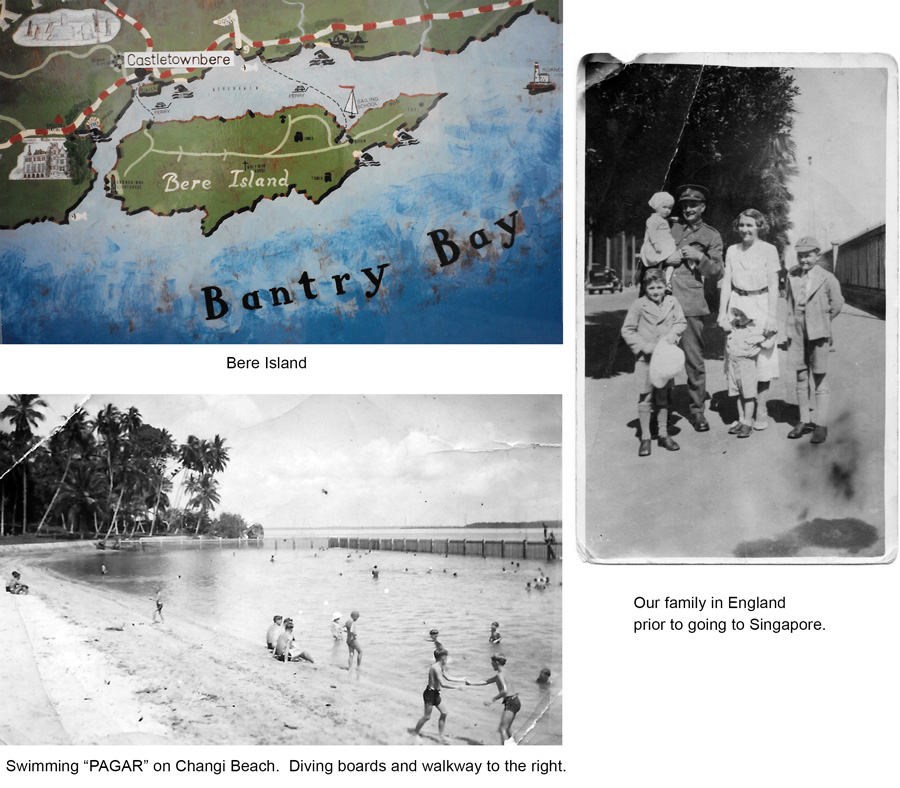
A daughter who died the same day, and two sons were born in India. We returned to England in 1933 and were posted to Chatham. After 18 months my husband was promoted to Quartermaster and posted to Aldershot where two more sons were born. In 1938 we were sent to Bere Island of the SW coast Ireland as QM of an AA Company pending handing over to the Irish Free State. During this time the crisis arose with Germany. Orders were being changed almost hourly “man the guns, man the lights, cancel our movement to England” unpack our belongings.
At last go ahead as planned, but, without husbands, A boat journey to Castletown Bere, 100 mile train journey to Cork, boat to Fishguard, train to Paddington, taxi to Victoria, train (now filled with reservists being called up) to Chatham. Taxi to barracks where we were shown to our new quarters which were two condemned barrack rooms.
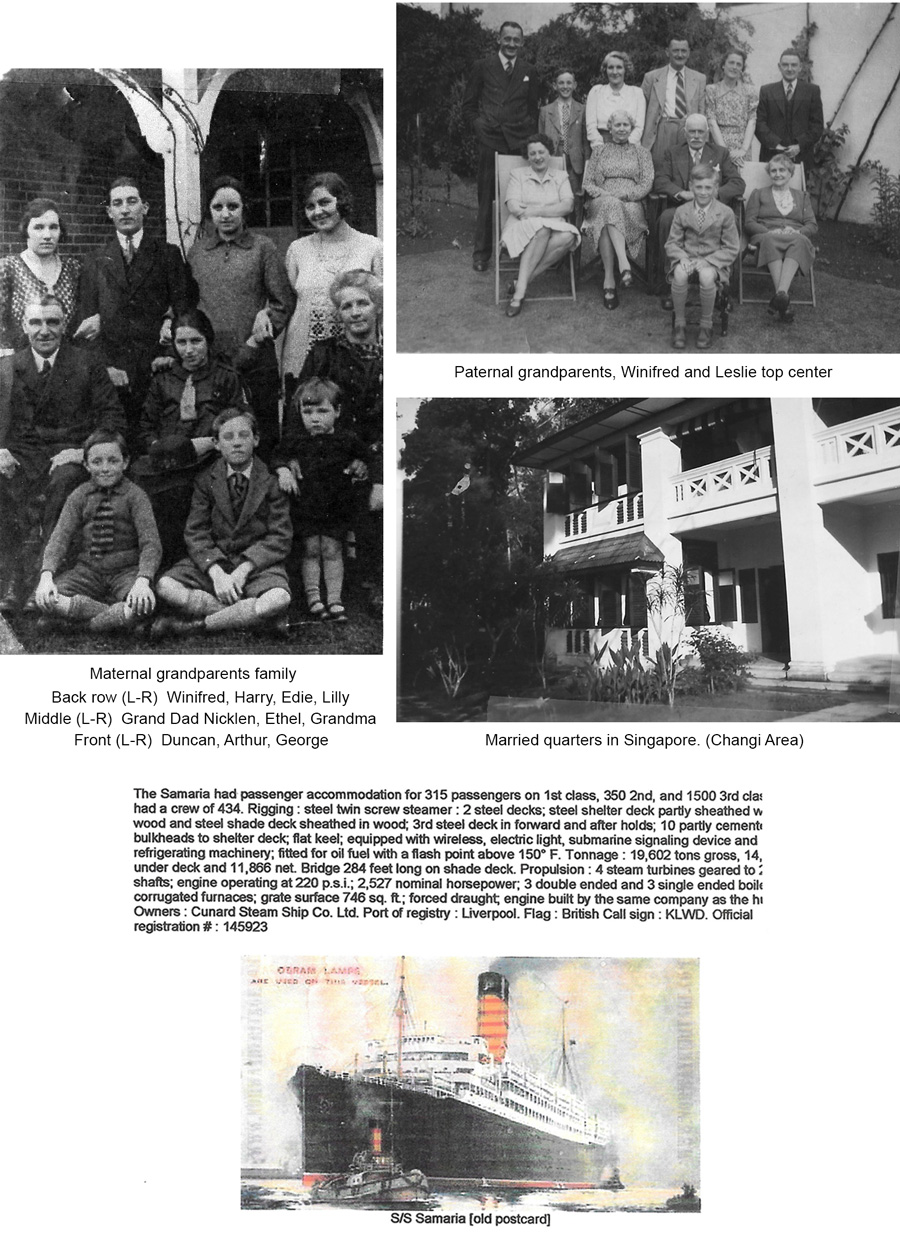
After 2 days the crisis passed and life continued until my husband returned from Bere Island to Preston Norfolk to continue closing down what had been an anti-aircraft company. He joined us a Chatham as Quartermaster early January and his first letter was his own posting to Malaya. We left England January 26, 1939 to sail to Singapore. During that year war was declared in Europe.
We spent the next 3 years in Singapore which was very pleasant until 1941 when the Japs struck.
Mum’s Time Line
1928 – 1933 India
1933 – 1938 England
1938 – 1939 Bere Island
1939 – 1942 Singapore
1942 – 1945 Scotland
1945 – 1947 Portsmouth
1947 – 1951 Ashley
1951 - ???? New Milton
I personally have only vague memories of my life up until Dad was posted to Bere Island, in Bantry Bay in the SW corner of Ireland. I see that while we remember it as Bere Island, a recent AA map now shows it as Bear Island. Interestingly the small town on the mainland, where we went shopping for supplies not provided by the army is still called Castletown Bere.
The trip to Castletown Bere was done on a ferry and I have vivid memories of fishing with a hand line, heavy lead weight (about the size of a sausage) and a spinner with a triple hook. The back of the ferry was semi-circular (it might have been a tug boat in earlier times) however fishing off of them was very productive (mostly pollack and mackerel) and it was a very poor trip if we didn’t have several to cart home. They were mostly about 18” – 24” long, a good meal, which we shared with other families on the island. I think it was then that I developed a taste of Mackerel, an oily fish but very tasty.
We were not destined to stay there long, Ireland was being roused up by De Valera and Bere Island became the last British outpost in Ireland. The partition, separating Southern Ireland and the Northern area, including Belfast and Dad was posted back to England.
Interestingly, Ireland was the first place I encountered where I was singled out for being English.
Bere Island was a paradise, as far as I was concerned. The island was very small, and the coast was very rugged, with lots of inlets, about, I would guess, 100ft long and 50 ft at the widest. The water was typically 10 to 20 feet deep and the bottom of the inlet was white sand. If you crawled up to the edge of the inlet you could look down and see the big fish swimming in the inlet. Standup and they would immediately swim back out to sea.
There were no paved roads on the island, mostly lanes with ditches on each side and hedges along the top. However, they were a wonderful source of bird’s nests and we would spend hours finding them.
It was during one of these trips that we met up with ethnic problems when we were confronted by grown men who cursed at us and threw rocks at us. We were terrified and ran like mad. It was not to be the last contact I had with the hate for the English.
Once back in England, it wasn’t long before Dad was posted to Singapore. A long trip by troopship via the Suez Canal.
1929 -1939