1980 -1983
In early 1982 we had a request from the Lamp Division in Bloomfield as to whether it was feasible to control street light lamps which had been exhibiting an early failure rate. The new lamps demonstrated good colour and was, in general fed from the so called “head peaked ballast” which was generally available from a number of suppliers. This meant that the two manufacturers ballasts were identical, hence the failure rate of the lamps.
The general characters were that the early failure lamps would get extremely bright dissipating more than their rated wattage. This overheat, sent up the voltage of the lamp until the ballasts wouldn’t supply the required voltage at which point the lamp would turn off, cool down and restart and keep on doing it.
I found a way to control the overheat problem using some commercial control circuits, but they would have been too expensive. So, I spoke to the manager of one of our sections who had been experimenting with a “do it yourself” integrated circuit. He quickly devised a circuit, obtained a prototype unit and was able to demonstrate a small modular control, fitting into a capacitor can with just 3 external leads which could be clamped on to existing points in the lighting fixture.
We were able to get a patent on the unit particularly as it was capable of automatic late-night dimming to conserve energy.
For the remainder of 1982 and into 1983 I worked primarily with the Gas Physics Dept. who were developing the largest Carbon Dioxide Laser in the world at that time. The laser itself was in a cyclonical pressure vessel with viewing points at each end. The laser itself was pulse energized and required an ultra violet pulse about 2 microseconds before the main pulse was applied. I devised a special array which would generate 1 million volts for 10 microseconds.
The result was most gratifying, with a fully reflecting mirror at one end of the pressure vessel and a reflecting mirror at the other end, the physicists were able to extract a laser bolt, which, when reflected and focused on to a target of furnace bricks would melt a hole right through them. The final customer was for military for anti-missile defense.
In about March of 1983 I came home late, as usual, and bought all my waiting mail to read while eating dinner, Jeannie leafed through my mail and found a general letter from our department manager asking for volunteers to join a small company in Florida which had just been bought by Westinghouse. The companies name was Vectrol and was based in Oldsmar, near Clearwater.
Needless to say, Jeannie was most excited and asked me to apply. I was a bit dismissive and said they probably needed young engineers. However, she persisted, and I promised to check into it the next day. So, in the morning I shuffled up to the managers office and spoke to the secretary, who informed me that, at that moment, I was the only one to apply.
Imagine my surprise when, about a week later, I was called up to the manager’s office to meet with Mr. Bob Sikora, the Chief Engineer of Vectrol.
He quizzed me as to why I wanted the job and I explained the reason, and after some discussing we agreed that:
a. I was too old
b. I was too expensive (as a fellow engineer)
On that note I left, feeling much happier, thinking I had scorched the idea.
It was not to be. About 3 weeks later I got a call to come to the manager’s office. There was Mr. Sikora.
“The jobs yours” he tells me.
I blurted out “I thought I was too old and expensive”
“You are” he says “but the management here tells he that I should grab you while I can”
To say the least of it, I was dumb founded. I couldn’t go back on my request, Jeannie would never have forgiven me.
They invited me down to the plant and I took them up on the offer.
The next thing was to take Jeannie down to Florida, but they pointed out that only one visit with spouse for house hunting was included, so one Friday we paid for ourselves to fly down and look around for 2 days. What we saw made Jeannie very happy and, on our next official visit we started house hunting in earnest or to be more accurate, Jeannie went off with a realtor everyday to find something she liked (she was never happy with our choice in Murrysville) while I went into the plant and familiarize myself with the Engineering and Manufacturing facilities and the range of equipment offered.
Sorry, that’s as far as Dad got on his biography.

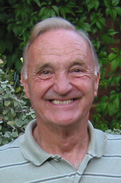
The picture above is Dad at the Oldsmar, Westinghouse Motor Control Division in Florida, he spent 13 happy years there and retired in 1996. After retirement he and his friend and colleague, fellow engineer Derek Paice worked on several engineering projects together for many years. My Mum (Jeannie) passed away on 3 Apr, 2017 and Dad passed away on 28 Jan. 2018, after 62 happy years of marriage.
1980 -1983